Paul Hayes Staff Writer
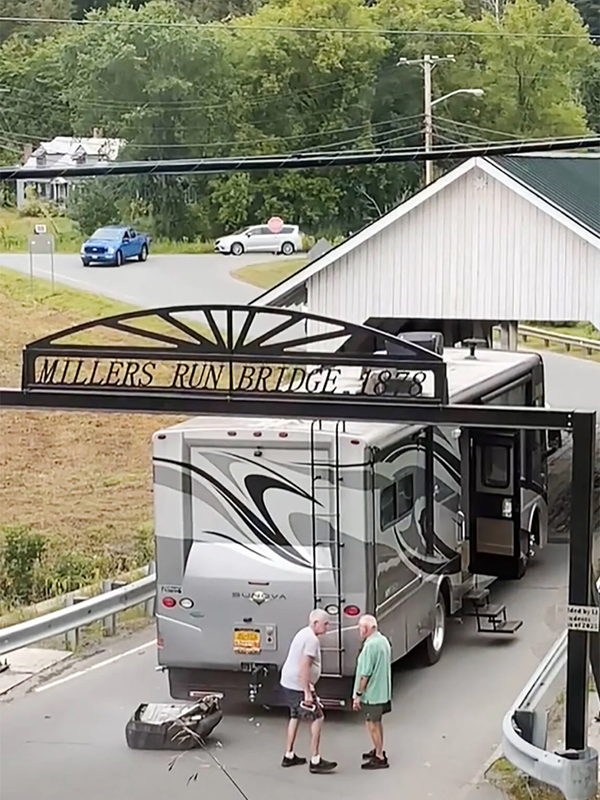
LYNDON — A camper struck the south barrier protecting the Miller’s Run Covered Bridge this week, the latest in a series of crashes that have demonstrated the value of the steel structures installed to keep oversized vehicles from damaging the historic span.
The owner and operator, James R. Thayer, 79, of Parish, N.Y., was on top of the motor home securing the second dislodged air conditioner, police said.
Thayer told police there were no signs along Center Street advising him that the motor home would not fit. Chief Jack Harris took Thayer back up the road and pointed out the clearly posted signs, police said.
There was no damage to the bridge or the steel barrier.
The incident is the latest example of the barriers doing what they were designed to do: stop vehicles that exceed the bridge’s 11-foot-9-inch clearance from reaching the wooden structure.
The barriers were installed in March 2025 after nearly three years of planning, replacing wooden boards on the north and south faces of the bridge with heavily anchored steel crossbeams. The 148-year-old bridge had been repeatedly struck by oversized vehicles, including at least four times in 2023.
Before the steel barriers were installed, each strike typically cost the town about $1,100 in repairs and often required the bridge to be closed while broken boards were replaced.
The $60,000 barrier project was designed by Lyndon Institute welding students and manufactured locally, with funding from voter-approved town funds and federal American Rescue Plan Act money. Town officials said it was a less expensive alternative to replacing the bridge, which could cost millions.
The barriers have been struck at least three times since they were installed, according to previous police and town reports.
In June 2025, a tractor-trailer attempting to enter the bridge was stopped when its exhaust stacks struck the southern overhead barrier. The truck backed away with minimal damage, and the bridge was not harmed.
In August 2025, a box truck struck the north barrier, causing heavy damage to the town-owned steel structure. Lyndon Institute welding students who helped build the barriers later repaired the damage, including straightening and restoring the decorative bridge sign and replacing a crossbeam.
The latest incident involved the south barrier. Although the motor home’s rooftop air conditioner was dislodged, neither the barrier nor the bridge was damaged.
The repeated strikes have prompted the Select Board to consider whether fines for height and weight violations at the bridge should also apply to drivers who hit the barriers. In 2021, the board increased those fines to $5,000 for a first offense, $10,000 for a second and $15,000 for a third.
The board has asked town counsel whether the existing penalties can be extended to barrier strikes or whether a new ordinance is needed.
When the barriers were installed last year, Town Administrator Justin Smith said the project was intended to solve the longstanding problem of oversized vehicles striking the bridge.
“Hopefully, this works and solves the issue once and for all,” Smith said at the time.
The barriers were designed not only to protect the bridge but also to complement it. The steel beams feature decorative arches and lettering reading “Miller’s Run Bridge 1878.”
Lyndon Institute welding students and instructor Ryan Brill helped design and fabricate the barriers as part of a community project involving the town highway crew, local businesses and other community members.
At the time of the installation, Smith said the project was a cost-effective way to protect the historic bridge.
“People will look at this as an expensive thing to do to protect a covered bridge,” said Smith, “but if you were to price out a two-lane bridge to replace it you’re talking a couple million dollars.”
Our thanks to the Caledonian Record for permission to reprint this article.
The full video can be seen below: