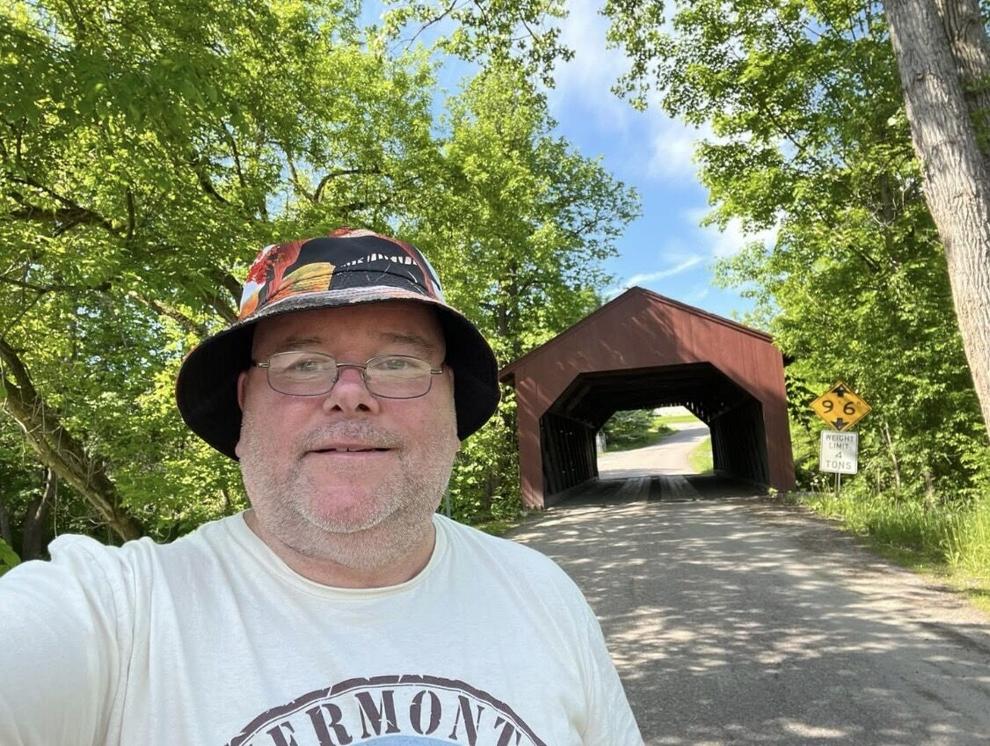
VERMONT — For some, the covered bridge is just a way to go here or there. For others, like Phillip Gatenby, they became a fascination, a quest and a chance to document history.
Gatenby’s quest started in 2024 when he first began his YouTube series documenting “Vermont’s 100 Covered Bridges.” The Englishman has since toured the state from its southern point to northern end.
There are a total of 203 covered bridges in Vermont, 99 of which are traditional or historical, according to the Vermont Covered Bridge Society. Gatenby is visiting each one to share its origins and history.
This past summer, Gatenby filmed in Franklin County, visiting eight bridges, including the very last one on his list, Enosburgh’s Hopkins Covered Bridge. The episodes will soon hit YouTube and the Okemo Valley TV and Brattleboro Community TV channels.
Before finding his way to Vermont, Gatenby was living in Florida with his wife. After settling into the Green Mountain State, he was quickly passing by covered bridges in Brattleboro which opened up another world to him.
“As you can gather from my accent, I’m not a native Vermonter,” he said. “I’d never seen a covered bridge before or even heard of them.”
Bridging the gap
At first, Vermont’s covered bridges were nothing more than an interesting facet of the landscape. Soon, Gatenby started noticing their different shapes and sizes and was hooked.
“In my spare time, I kept Googling, and there were hundreds of them. I went on YouTube to find more information and people were visiting these bridges,” he said. “I was fascinated. Found out in Lyndon, someone went to all five in one short video, and then I went to see if they went to other towns and they hadn’t. I was disappointed because it was an informative video. I realized there’s nothing really out there. Lots of people see the bridge and drive through, that was it.”
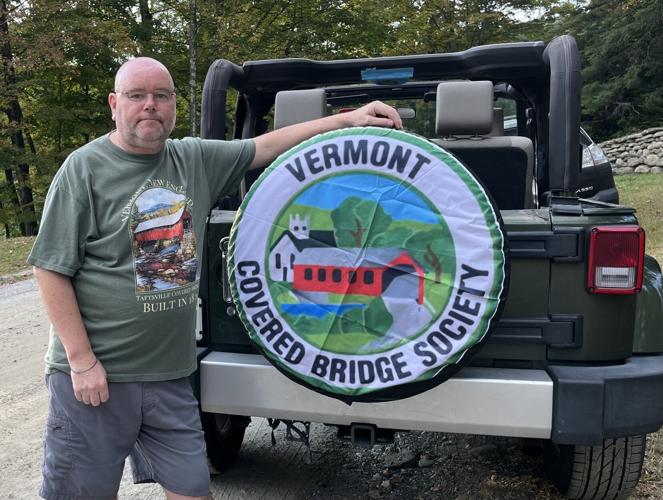
As someone keen on learning more and asking questions, Gatenby got in touch with the Vermont Covered Bridge Society, became a member and pitched his idea. They agreed, offered help and Gatenby was off.
“It just enabled me to see a side of Vermont I would never ever have got to see otherwise. Dirt tracks in the middle of nowhere, but I did get all seasons, a year in Vermont,” he said. “I imagine there are people who lived their whole lives in Vermont who never got to see some of this.”
Covering history
Gatenby’s fascination in part comes from a different upbringing. It’s a part of history he wasn’t well-versed in and an interesting look into a different kind of life generations ago.
“I grew up in England. I went on a school trip to Shakespeare’s birthplace in the 1500s. There’s nothing here that old, but the covered bridges are one remaining link to the past,” he said.
And, while the covered bridges are celebrated today for their picturesque views, they are also a relic from a different lifestyle.
The sheer workmanship which went into the structure without any cranes or modern equipment is beyond what we would expect today, Gatenby said.
In Montgomery for example, Gatenby pointed to the Jewett brothers’ work. They made a number of the bridges in the area, of which a few remain standing. It was just a number of people working together defining the style and important locations of the area.
“They were all tied into factories who needed water to run the mills to make large butter tubs which were transported over the bridge and to railway lines,” he said. “So it’s everything. It’s not just a bridge, but also an industry that connected with mills built next to water, which therefore needed the bridge to get to and from the factory.”
Gatenby himself finds the history of the iconic bridges something to find joy in and each YouTube video is a document to a structure that could be lost forever.
“There’s two in danger of going. One-hundred is a magical number but there’s one in Lyndon and a private bridge in Irasburg in danger of getting lost because they’re beyond repair and finances,” he said. “It’s important to highlight each bridge, document it and fingers-crossed hope they’re not lost, but also to raise awareness of what’s going on and what bridges need saving. Once they’re gone, they’re lost.”
In each 10-15 minute video, Gatenby drives through the bridge, walks around and under it, and shares the architectural style and unique findings of each.
“Like I say, they are a remarkable piece of history still standing,” Gatenby said.
Viewers who want to brush-up their knowledge on Vermont’s famous bridges can find the nearly hundred videos at Vermont’s 100 Covered Bridges on YouTube. Fairfax’s Maple Street bridge kicks off the Franklin County leg of the series.
Our thanks to the Saint Albans Messenger for permission to reprint this article.