Paul Hayes Staff Writer
LYNDON — Plans to return the historic Sanborn Covered Bridge to its original crossing over the Passumpsic River have been abandoned, town officials said, ending a five-year effort to restore the span.
At Monday’s Select Board meeting, officials said the project can no longer move forward as designed due to a combination of obstacles, including the inability to secure a key easement and Act 250 approval, delays tied to major flooding and federal disaster recovery work, and grant timelines that have effectively run out.
“We don’t see a viable path forward to get the easement that we want and to get through the Act 250 [state permitting] issue… we’re out of time, essentially,” said Select Board Chair Christian Thompson. “And the backers of the project would like their funds back to be able to fund other projects that are more ready to go forward.”
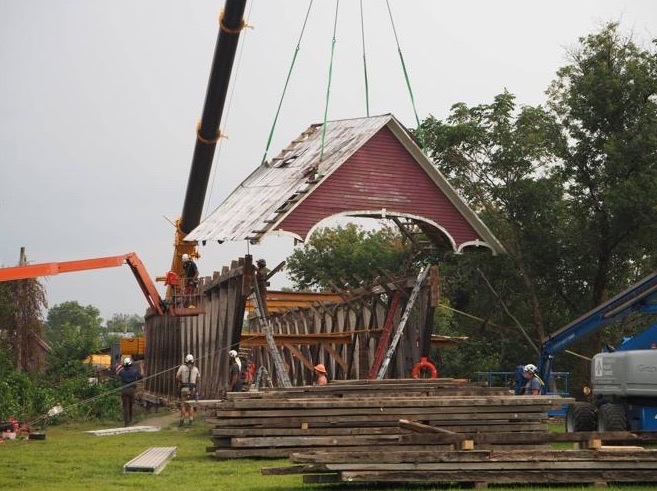
The decision means the bridge — dismantled and removed from the river after severe flood damage — will not be reassembled on its original abutments. Officials said the town will instead explore relocating it, potentially to a site on land.
Easement, Redesign And Regulatory Hurdles Derail Project
Town officials said efforts to secure the necessary approvals, including a key easement, stretched for roughly 18 to 24 months without success.
“We’ve been trying to get approvals, especially on an easement, for nearly two years,” Thompson said. “That doesn’t look like it’s going to materialize.”
Without that access, officials said, the project could not proceed regardless of available funding.
“Without that, we could have all the money in the world, and we can’t move forward… we can’t move forward with putting the bridge back where it was, the bridge as it was designed, the project as it was designed,” Thompson said.
The easement issue arose after the project was redesigned to address flood risks.
Plans to restore the 157-year-old bridge began more than two years ago but were revised following the catastrophic July 2024 flood. Using modeling data from SLR International, the town developed a new design to raise the bridge more than four feet, rebuild its abutments and improve water flow.
The redesign, requested by the town’s Hazard Mitigation Committee, aimed to improve flood resilience and public safety by increasing the opening beneath the bridge and elevating it above the 500-year flood level.
Those changes required a different project footprint and additional property access, necessitating a new easement and additional regulatory review.
In a Feb. 3 jurisdictional opinion, state officials ruled that reconstruction would require an Act 250 permit, finding the revised project represented a “material change” tied to development review at the former Lyn-Burke Motel property.
The opinion said the bridge project could have “a significant impact” on river management plans associated with a proposed gas station and mini-mart at the site.
Town officials said the redesign stemmed from concerns identified in the SLR study about the bridge’s role in restricting water flow.
“We hired an engineer that led to the conclusion of the Sanborn bridge abutment being a major factor in what holds the water back at the north end of town,” Town Administrator Justin Smith said.
Officials said that the finding underscored a conflict between historic preservation and public safety.
“You have two worthy goals. You want to see the Sanborn bridge back over the river, but you have a science-based engineering report that says that that’s the cause of a lot of the restriction of flow of water… and you’re talking about other properties, damage to buildings, possibly… risk to human life,” Smith said.
Grants withdrawn as timelines expire
At the same time, grant deadlines have forced funders to withdraw support. The town is returning a $100,000 Paul Bruhn Historic Revitalization Grant administered through the Preservation Trust of Vermont.
“We’re essentially turning those funds back to them… They only have until the end of this year to use it,” Thompson said.
Smith said the town had already indicated it would not meet the timeline.
“We told [the Preservation Trust] that we were probably not going to be able to use these [funds] in that time frame — and they had another worthy candidate that they could pivot to for these funds,” Smith said.
Because the bridge will no longer span the river, the project also no longer qualifies for a roughly $300,000 Vermont Agency of Transportation Transportation Alternatives grant, which included a $75,000 local match. About $41,000 of that funding was spent on engineering.
“We spent about 41,000 of that on engineering, which they said was an allowable use…” Smith said.
Town officials said the project had secured about $2.1 million in grant funding overall, though it remains unclear how much, if any, could be applied to a redesigned project.
Of that total, about $550,000 has already been spent, including emergency removal of the bridge ahead of Tropical Storm Debby in 2024 and engineering work.
Our thanks to the Caledonian Record for permission to reprint this article.